AML verification - even when your tenant has no UK documents.
Expats, relocators, and international tenants can't provide utility bills. WhyAML verifies them anyway - without documents.
Letting agent showing keys to an international tenant couple. Modern flat or apartment doorway. Both smiling - the deal went through. Genuine, warm.
The expat tenant problem
There's millions of them. They have money, jobs, and no UK footprint.
Corporate relocations, American expats, EU professionals, digital nomads - they have money, they have jobs, they just don't have UK address history. Traditional AML fails them. You lose the tenant.
Sound familiar?
You became a letting agent to fill homes - not to turn away good tenants.
"The tenant had funds, references, a job. They just didn't have UK utility bills. My system rejected them. They went to another agent who found a workaround. I lost the tenancy and the commission."
Sound familiar?
See how WhyAML solves this
Four reasons your software rejects good tenants.
The system was built for UK residents with full paper trails. Your tenants are neither.
No UK utility bills
They just arrived. They haven't set up utilities yet. Your address-proof check returns nothing - so your system rejects them as unverifiable.

No UK credit history
Credit checks return nothing - not because they're risky, because they're new. Your system reads unknown and treats them as a threat.

Foreign documents rejected
Traditional AML software can't verify non-UK passports. The very clients who need verification are the ones it can't handle.

Share codes don't satisfy AML
Share codes prove right to rent. They do not prove identity for AML purposes. HMRC wants more and your software doesn't deliver it.

Your next tenant might hold crypto.
The UK rental market has shifted. Millions of adults - especially in the 29-44 age bracket who make up most of the rental demographic - now hold crypto assets. Traditional source-of-funds verification doesn't capture this. WhyAML does.
Derived from FCA 2025 ownership rates (8%) applied to ONS 2024/25 population data.
FCA 2025 data noting a shift toward higher average holdings among active investors.
FCA 2025 age-stratified research.
FCA Consumer Research (Wave 6), Dec 2025.
From 2026, crypto activity falls under formal UK regulation - the exact institutional evidence WhyAML already uses to verify tenants.
HM Treasury & FCA Joint Policy Statement on the Financial Services and Markets Act (Cryptoassets) Regulations 2026.
Use what they DO have - a verified exchange account.
Tier 2 regulated exchanges verify identity globally. If your tenant holds an account with one - from New York or Berlin - they've already been through institution-grade KYC.
We confirm they control that account - no UK utility bill required.

A confidence engine called G-RADE™.
The Witness Model observes what a regulated institution already knows about your tenant. G-RADE grades what it sees - four signals from seven, none of them fakeable by AI.
Four steps. No documents.
Same for every tenant, no matter the nationality.
Add tenant
You add them in the portal.
Send link
WhyAML sends a secure link direct to the tenant.
Tenant verifies
They verify through a regulated exchange - no UK address needed.
Certificate
You receive the compliance certificate. Done.
No documents. No passport. No UK address required.
Any nationality with a regulated exchange.

American expats
US passport + a Tier 2 regulated exchange account = verified. No UK credit history required.

EU professionals
EU passport + a Tier 2 regulated exchange account = verified. Works across all 27 states.

Corporate relocations
Any nationality with a regulated exchange account. Senior executives, no documents required.

Digital nomads
No fixed address but verified identity through their exchange. The future of work, solved.
One reliable source. That's it.
"Verify the customer's identity on the basis of documents or information obtained from a reliable source which is independent of the person whose identity is being verified."
It does not say UK utility bill. It does not say UK credit history. It says: a reliable, independent source. A Tier 2 regulated exchange is one. A Tier 1 institution is one.
What you actually get
Not just verification - protection.
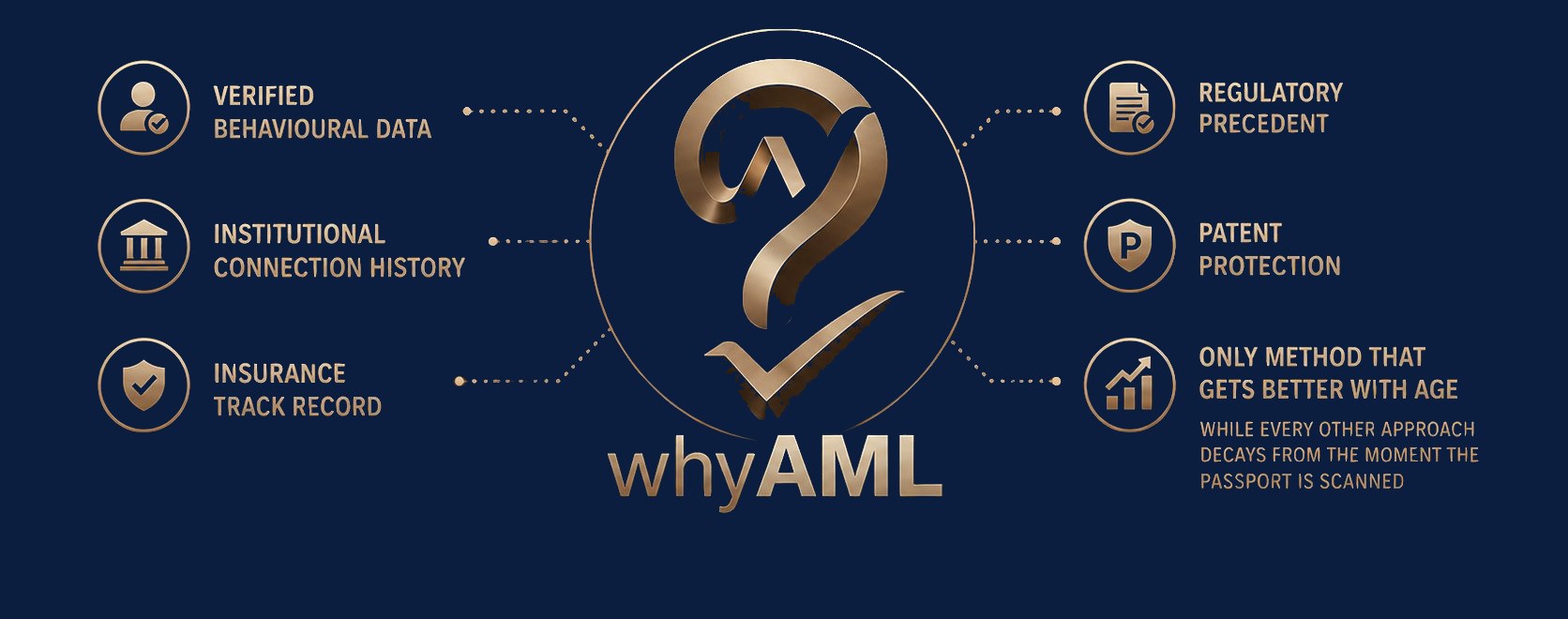
Verified Behavioural Data
Real signals from how your client uses the regulated accounts they already hold - transaction patterns, dormancy, institutional connections. Observed, never collected, and impossible to synthesise or fake.
HMRC compliant. MLR 2017 ready.
The Money Laundering Regulations require a reliable, independent source of identity verification for every customer relationship.
WhyAML's Witness Model: identity verified via a regulated institution - a Tier 2 regulated exchange or a Tier 1 institution - which is exactly what Reg 28 defines as a reliable source.
Stop losing good tenants to broken software.
The rules were written for UK-born residents with utility bills. Your tenants don't fit. That's not their fault and it shouldn't cost you tenancies. WhyAML closes that gap.
Want the detail on tenants with no UK paperwork? How expats and overseas tenants are verified